
Fan Coil Units
The vast majority of residential high-rise buildings located in Ontario are cooled, heated, and ventilated using a fan coil. The vertical fan coil became a popular option throughout the HVAC industry in the early 1970s when manufactures developed this system as an economical way to heat, cool, and ventilate a residential space over baseboard radiation systems.
If left unattended, aging fan coil units can directly affect the indoor air quality of a residential high-rise building's suites and common areas
WHAT IS A
Fan coil unit?
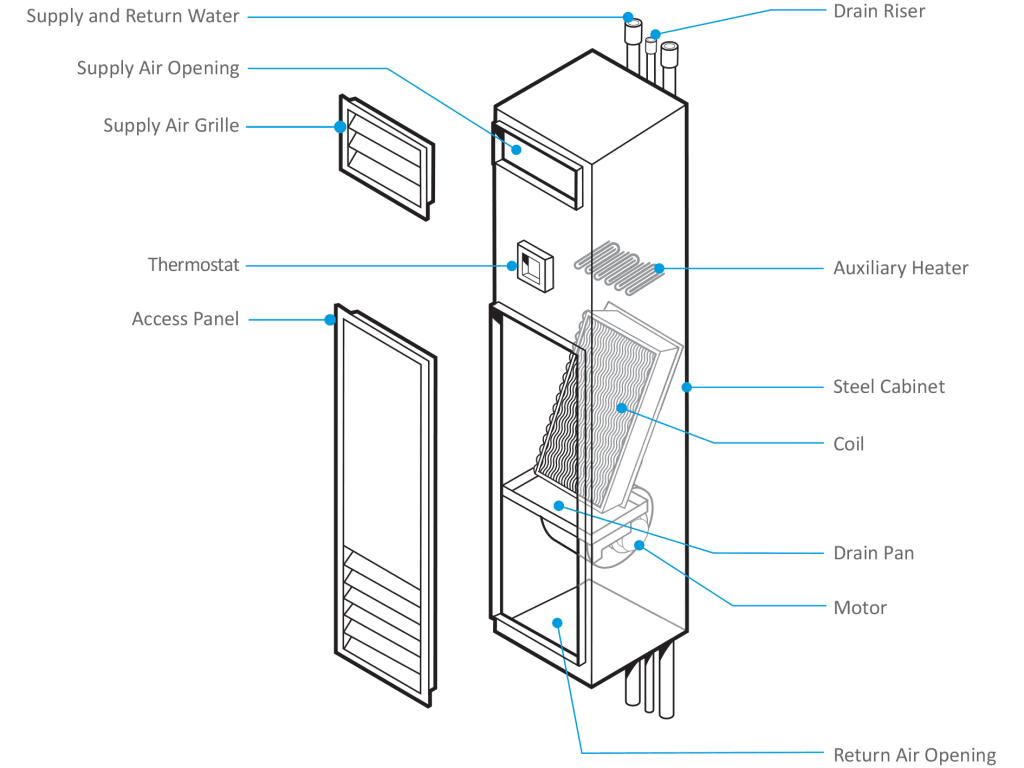
Vertical fan coils are a type of HVAC system that consists of a fan and a coil that circulates hot or cold water to heat, cool, and ventilate the suites and common areas. The building’s make-up air unit draws in fresh air from outside, pressurizing the corridors which pushes air into suites. Fan coils draw in air from the suite, condition it, and then supply it back into the suite. The thermostat found in a suite controls all these features. The vertical fan coil can be found behind an access panel, in the wall, within the suite.
CHALLENGES WITH
Aging fan coil units
A fan coil is one of the only pieces of equipment in a building in constant operation. Like a furnace in a single-family home, it has an expected lifespan. While Unilux products are incredibly durable, with some of our original fan coils still in operation, units over 20 years old should be inspected by the original equipment manufacturer to assess the condition. Fan coils in buildings older than 20 years have a higher risk of having these issues:
Problem: Flat, galvanized steel drain pans allow for pooling and corrosion over time, creating holes for condensate water to leak through, resulting in water damage and floods. Corroded supply and return valves can not only leak, they may not allow you to shut the water supply off to the unit in the case of other leaks or floods leading to much greater water damage.
Solution: Stainless steel drain pans that are sloped towards the drain, ensuring that water does not corrode the pan or pool. New modern ball valves allow for easy water shut off, reducing the probability of catastrophic water damage.
Problem: Age, humidity, lack of maintenance, and fiberglass deterioration are common issues resulting in mould growth.
Solution: A Unilux replacement unit uses closed cell foam insulation with anti-microbial properties in place of fiberglass to prevent moisture absorption and deterioration.
Problem: Older fan coil unit cabinets where insulated using fibreglass insulation. Over time, this insulation deteriorates depositing particulate matter into the drain pain that can plug up the drain leading to flood risks. Additionally, glass fibres will enter the air flow, which can then be inhaled. Finally, exposed fibreglass creates an ideal environment for microbial growth.
Solution: modern materials like closed cell foam elastomeric insulation is microbial resistant, less prone to age related degradation, has a higher R-value than fibreglass, and has greater sound dampening properties.
Problem: As fan motors lose torque and coils get clogged with dirt, airflow drops. Furthermore, these aging units lose their heat transfer efficiency, which means that they must run significantly longer to achieve target temperatures.
Solution: New variable speed blower motors paired with modern stainless steele housed coils provide better heat transfer efficiency with less electrical power consumption.
Problem: As fan coils age, corrosion, deterioration and debris cause appreciable increases in operating volume.
Solution: A study by WT&A Engineering found that new retrofit fan coils are up to 5 dB quieter than existing fan coils.